Mobile Neuro-Physiotherapy Visits Across Eastern Province — 100% Home Delivery
•Eastern Province Scheduled Visits
Specialized Parkinson's Home Care • Eastern Province
Live Home Visits Available

Advanced Neurological Physiotherapy for Parkinson's Disease

Empower Parkinson's patients to regain postural stability and fluid mobility within their own living room in Eastern Province. Utilizing rhythmic auditory/visual cueing and amplitude training, we help overcome bradykinesia, unlock freezing of gait, and prevent dangerous domestic falls.

Sensory cueing methods to override gait freezing and hesitant step initiation
High-amplitude functional training to reverse stooped posture and shuffling
Precise session timing coordinated with dopamine medication (On/Off cycles)
Thorough domestic fall-risk audit removing tripping hazards from walkways
4.9/5 ⭐⭐⭐⭐⭐ (Trusted by 450+ families across Eastern Province)
Clinical triage response on WhatsApp within 15 minutes
Male & Female Specialists Available
Direct home visits scheduled in Dammam, Khobar, Dhahran, Qatif, Saihat, Jubail, & Al-Ahsa.
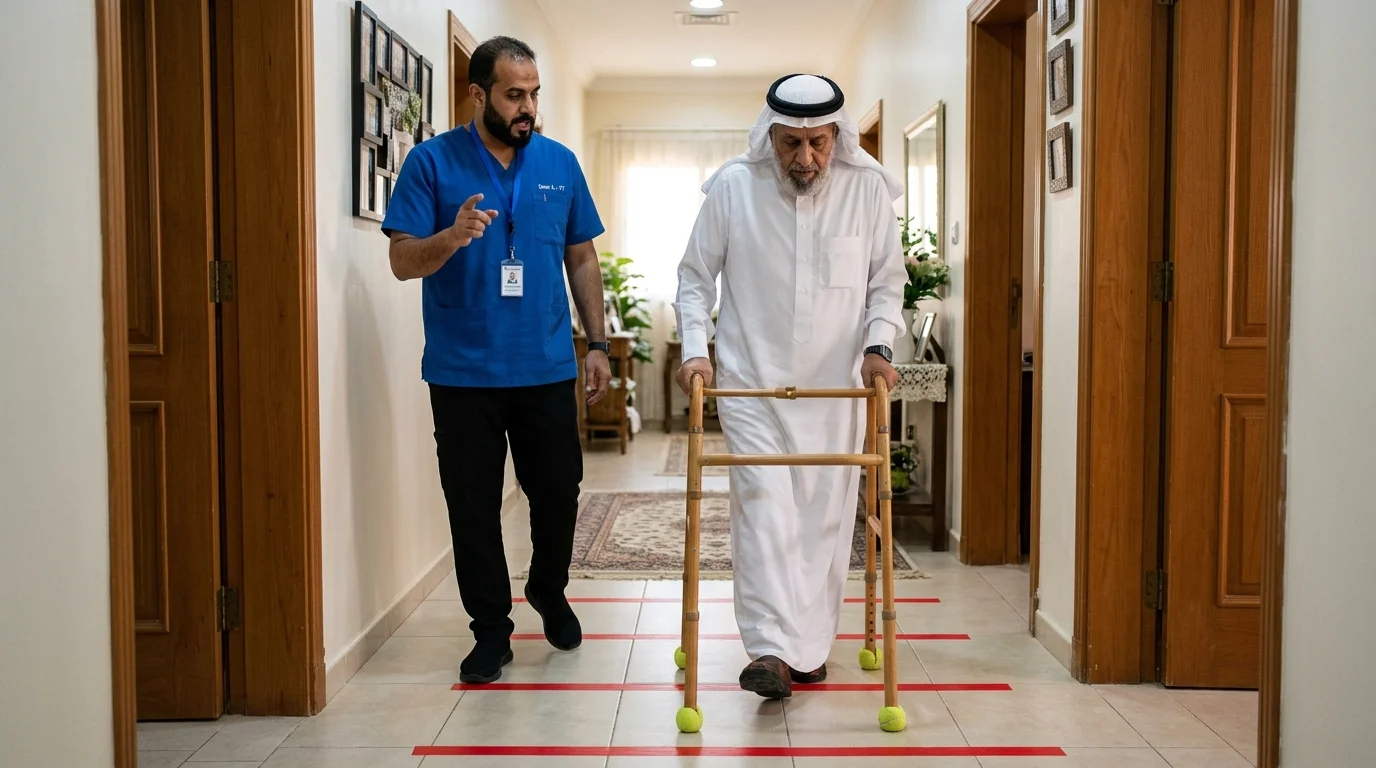
Parkinson patient practicing amplitude gait training and stepping over visual floor markers with therapist cueing
1

Neuropathology of Parkinson's: Why Standard Exercise Fails and Specialized Cueing Succeeds

Parkinson's disease is a progressive neurodegenerative disorder marked by the degeneration of dopaminergic neurons within the substantia nigra pars compacta, disrupting basal ganglia thalamocortical motor loops. Because the basal ganglia function as the brain's 'autopilot' for routine, sequential, and automatic movements, dopamine depletion produces the classic motor triad: resting tremor, lead-pipe or cogwheel rigidity, and profound bradykinesia (slowness) and hypokinesia (small movement amplitude).

Traditional physical fitness routines fail because the deficit is not muscular weakness, but a failure of internal motor cueing and scaling. Bidaya's neurological protocols bypass damaged basal ganglia circuits by recruiting conscious, goal-directed cortical pathways in the frontal lobes via external sensory cues and high-amplitude practice.

Bypasses impaired automatic motor loops via conscious frontal cortex recruitment.
Recalibrates the patient's distorted internal sensory perception of movement size.
Meticulously coordinates exercise intensity with optimal medication 'On' windows.
Prevents domestic falls that lead to devastating femoral fractures.
2

Clinical Interventions for Freezing of Gait (FOG)

Freezing of Gait is a terrifying motor block where patients feel their feet are 'magnetized to the floor', typically occurring during gait initiation, doorway passage, or turning. Bidaya implements proven sensory cueing protocols directly in the patient's home:

Visual Cues: High-contrast transverse floor lines taped across narrow doorways and hallways, transforming an automatic walking block into a conscious visual task of 'stepping over the line'.

Auditory Rhythmic Cues: Metronome pacing or rhythmic verbal cadence ('one, two, big step') that synchronizes motor output through auditory cortical pathways.

Lateral Weight-Shifting: Coaching patients to gently sway weight laterally before taking a step, unweighting the stepping limb.

3

Amplitude Retraining: The Power of Thinking BIG

Parkinsonian hypokinesia causes patients to take tiny, shuffling steps while believing their movement is normal. We employ amplitude training (LSVT BIG concepts): demanding exaggerated arm swings, high knee lifts, and oversized steps, recalibrating the brain's internal kinesthetic scale toward normal movement volume.

4

Postural Realignment and Fall Prevention

We address stooped forward posture (camptocormia) through thoracic extension exercises and scapular retractor strengthening. Furthermore, we train wide-arc turns to eliminate abrupt pivoting, which is the leading cause of backward falls (retropulsion) in Parkinson's.

5

Medication 'On/Off' Phase Synchronization

Therapy sessions are scheduled approximately 45 to 60 minutes after levodopa administration, capitalizing on the peak 'On' medication phase when neuroplastic motor learning is most receptive.

6

Advanced In-Home Clinical Assessment Battery and SMART Milestones for Parkinson's Disease

The clinical success of in-home neurological rehabilitation for Parkinson's Disease depends fundamentally on the depth and precision of the baseline diagnostic evaluation performed in the patient's residence. Rather than relying on subjective observation or generic exercise routines, Bidaya implements an internationally standardized clinical assessment battery designed to map the structural and functional integrity of the central and peripheral nervous systems.

Our comprehensive baseline evaluation quantifies muscle tone and velocity-dependent spasticity using the Modified Ashworth Scale (MAS), isolates selective voluntary motor control outside pathological mass synergies via the Fugl-Meyer Assessment (FMA), and evaluates static and dynamic equilibrium using the Berg Balance Scale (BBS) and the Timed Up and Go (TUG) test. Sensory modalities — including light touch discrimination, pinprick, and joint position sense (proprioception) — are meticulously charted to identify sensory ataxia or neglect syndromes.

Based on these objective metrics, our senior neurological physiotherapist collaborates with the patient and family to establish Specific, Measurable, Achievable, Relevant, and Time-bound (SMART) functional milestones. These goals are explicitly tied to authentic daily domestic routines: mastering unassisted rolling in bed within two weeks, rising autonomously from a standard residential armchair within four weeks, or achieving stable indoor ambulation across domestic hallways without physical assistance.

Precise neurological documentation tracking deep tendon reflexes and clonus suppression.
Continuous physiological monitoring of blood pressure, heart rate, and oxygen saturation during exertion.
Targeted identification of isolated muscle deficits to guide functional neuromuscular stimulation (NMES).
Sharing comprehensive digital progress summaries with treating physicians across Eastern Province hospitals.
7

Caregiver Empowerment and Domestic Safety Protocols for Parkinson's Disease

Extensive peer-reviewed rehabilitation research demonstrates that while direct clinical therapy sessions provide high-intensity neuroplastic stimulation, the remaining 23 hours of the patient's day are managed by family members and domestic caregivers. If caregivers lack proper biomechanical training, well-intentioned assistance — such as aggressively pulling on a hemiparetic arm during transfers — can produce catastrophic musculoskeletal injuries, severe shoulder subluxation, and chronic pain syndromes.

Bidaya dedicates structured time during every home visit to coach family members and domestic nurses in safe, ergonomic transfer mechanics. We train the biomechanical 'Head-Hips Relationship' to facilitate effortless transfers between bed, wheelchair, and sofa without placing compressive strain on the caregiver's spine, alongside strict rotational repositioning protocols to eliminate pressure injury risks.

Furthermore, we provide structured, illustrated Home Exercise Programs (HEP) detailing gentle active-assisted movements, safe positioning techniques using anatomical pillows, and clear activity boundaries, transforming the household into an empowering 24-hour therapeutic sanctuary.

Strict prohibition of traction forces on the paretic shoulder to prevent rotator cuff tears.
Anatomical positioning guidelines using contoured pillows to preserve symmetrical trunk alignment.
Training caregivers to encourage active patient participation rather than fostering learned helplessness.
Direct coordination channels with the supervising clinician for prompt guidance on daily care challenges.
8

Local Residential Adaptation and Mobile Clinical Field Logistics in Eastern Province

Residential properties in Eastern Province feature generous architectural spaces that provide outstanding opportunities for neurological motor relearning, including expansive living halls, wide hallways, and private outdoor verandas. However, these spaces also present real-world environmental hazards — such as polished marble flooring, decorative floor rugs, and threshold steps — that can precipitate dangerous falls if unmanaged.

During our initial home visits in Eastern Province, Bidaya clinicians conduct a thorough domestic safety audit, identifying slip and trip hazards and advising families on practical, unobtrusive modifications. These include securing rug perimeters, recommending secure wall-mounted grab bars in bathrooms, optimizing lighting along nocturnal pathways, and adjusting seating heights to match the patient's biomechanical joint angles.

Moreover, our mobile operations in Eastern Province are strategically scheduled by regional neighborhood clusters, ensuring prompt, reliable arrival that avoids peak arterial highway congestion and preserves the patient's physiological stamina for productive therapeutic exercise.

Systematic hazard screening across hallways, thresholds, and bathroom transfer zones.
Optimizing residential seating heights to facilitate natural sit-to-stand momentum transfer.
Coordinating session arrival to harmonize with patient medication schedules and prayer times.
Customizing mobility training to the unique architectural dimensions of the patient's residence.
9

Comprehensive Clinical Prevention of Secondary Complications in Parkinson's Disease

Effective management of chronic or subacute Parkinson's Disease requires aggressive prevention of secondary complications arising from prolonged immobility or abnormal compensatory kinematics. Left unaddressed, these secondary pathologies can become more physically limiting and painful than the primary neurological lesion itself.

Chief among these risks are fixed soft-tissue contractures resulting from sustained uninhibited spasticity, disuse osteoporosis caused by lack of skeletal axial loading, dependent peripheral edema with deep vein thrombosis (DVT) risk, and pulmonary atelectasis stemming from shallow diaphragmatic excursion during prolonged recumbency.

Bidaya's home neuro-physiotherapy integrates multi-tiered preventive strategies: applying sustained low-load prolonged stretching to vulnerable muscle groups, introducing supported weight-bearing standing protocols to stimulate osteogenesis, utilizing active muscle pumps and electrical stimulation to enhance venous return, and practicing deep diaphragmatic re-expansion to maintain pulmonary compliance.

Regular passive and active-assisted range of motion protocols to preserve articular mobility.
Facilitating safe upright standing to stimulate bone mineral density and reduce spastic tone.
Activating calf muscle pump mechanisms to prevent dependent peripheral edema and circulatory stasis.
Incentive spirometry and diaphragmatic breathing exercises to safeguard respiratory vitality.
10

Clinical Governance, Objective Documentation, and Quality Benchmarks at Bidaya

Bidaya adheres strictly to international clinical governance frameworks established by premier neurological physical therapy organizations worldwide. Our home visit service is characterized by rigorous longitudinal documentation and transparent milestone verification using validated outcome batteries.

At the conclusion of each therapeutic block, our supervising clinical director reviews serial functional scores (Fugl-Meyer, Berg Balance, TUG, and Modified Barthel Index), synthesizing these data points into an encrypted clinical progress report. This report is shared directly with the patient, family, and treating neurologist at tertiary centers across the Eastern Province, ensuring seamless multidisciplinary continuity of care.

Serial digital outcome tracking verifying functional gains at standardized intervals.
Peer-reviewed clinical protocol updates incorporating the latest neuroplasticity research.
Absolute confidentiality and ethical data stewardship safeguarding family medical privacy.
Uncompromising dedication to restoring patient dignity, self-reliance, and physical autonomy.
11

Long-Term Motor Maintenance and Sustainable Community Reintegration

Neurological recovery is a cumulative, lifelong journey requiring continuous synaptic reinforcement to prevent disuse deconditioning and regression. Bidaya establishes a phased transitional framework that guides patients from intensive restorative therapy to autonomous domestic mobility and sustained physical vitality.

We train patients and family members to embed therapeutic exercises seamlessly into natural daily rituals: practicing dynamic balance during daily standing routines, actively utilizing the paretic extremity for stabilizing household items, and undertaking supervised daily walking along secure residential corridors or private garden pathways.

Establishing an enduring home exercise routine that safeguards neuromuscular gains.
Periodic monthly clinical follow-ups to re-evaluate balance metrics and gait velocities.
Progressive calibration of home exercise resistance and balance difficulty levels.
Fostering psychological resilience and active participation in family and social life.

Clinical Topics in Parkinson's Disease Care

In-Home Management of Freezing of Gait & Sensory Cueing in Parkinson'sEastern ProvinceAdvanced In-Home Neurological Physical Therapy for Parkinson's DiseaseEastern ProvinceGait Retraining & Festination Control for Parkinson's Disease at HomeEastern ProvinceIn-Home Balance Retraining & Retropulsion Fall Prevention in Parkinson'sEastern ProvinceIn-Home Exercises to Overcome Bradykinesia & Micrographia in Parkinson'sEastern ProvinceSafe Turning Strategies & Pivot Control for Parkinson's Patients at HomeEastern ProvinceIn-Home Sit-to-Stand Biomechanical Retraining for Parkinson's PatientsEastern ProvincePostural Alignment & Camptocormia Management in Parkinson's DiseaseEastern ProvincePrescription & Training with Specialized Walkers in Parkinson's DiseaseEastern ProvinceIn-Home Geriatric Mobility Care for Seniors with Parkinson's DiseaseEastern ProvinceStretching & Muscle Rigidity Relief Protocols in Parkinson's DiseaseEastern ProvinceSynchronizing In-Home Physical Therapy with Parkinson's Levodopa CyclesEastern ProvinceFestinating Gait & Involuntary Acceleration Management in Parkinson'sEastern ProvinceOvercoming Doorway & Threshold Freezing in Parkinson's DiseaseEastern ProvinceRhythmic Auditory Stimulation (RAS) & Metronome Cueing in Parkinson'sEastern ProvinceVisual Cueing & Laser Floor Line Strategies for Parkinson's GaitEastern ProvinceDual-Task Motor-Cognitive Training in Parkinson's DiseaseEastern ProvinceMicrographia & Fine Motor Finger Dexterity in Parkinson's DiseaseEastern ProvinceCamptocormia & Severe Forward Postural Flexion in Parkinson'sEastern ProvincePisa Syndrome & Lateral Trunk Tilt Management in Parkinson'sEastern ProvinceRetropulsion & Sudden Backward Falls Management in Parkinson'sEastern ProvincePostural Ergonomics & Safe Positioning for Swallowing in Parkinson'sEastern ProvinceAxial Rigidity & Segmental Trunk Rotation Exercises in Parkinson'sEastern ProvinceHigh-Amplitude Movement & Big-Scale Motor Retraining in Parkinson'sEastern ProvinceOrthostatic Hypotension & Safe Stand Transitions in Parkinson'sEastern ProvincePalliative Motor Care & Comfort Preservation in Late-Stage Parkinson'sEastern ProvinceFreezing of Gait During 180-Degree Turning in Parkinson's DiseaseEastern ProvinceCognitive-Motor Dual-Task Ambulation Drills in Parkinson'sEastern ProvinceLarge-Amplitude Movement Training for Hypokinesia in Parkinson'sEastern ProvinceRetropulsion & Precipitous Backward Fall Mitigation in Parkinson'sEastern Province
Safety Screening

Home Fall Risk Educational Check

Identify potential mobility challenges, furniture leaning, and domestic hazards that impact balance confidence.

Frequently Asked Clinical Questions

Q

Can physical therapy slow the progression of Parkinson's disease?

Clinical evidence demonstrates that vigorous, continuous neurological exercise promotes neuroprotective neurotrophic factors (like BDNF), slows functional decline, and preserves mobility.

Q

What should a caregiver do when a Parkinson's patient freezes while walking?

Never pull or push the patient. Instruct them to stop, stand tall, take a deep breath, rock gently side-to-side, and step over a visual line or the caregiver's foot with an exaggerated high step.

Q

Is tremor the primary cause of balance falls in Parkinson's?

No. Impaired postural reflexes, axial rigidity, and bradykinesia are the primary culprits behind falls. Our therapy focuses on widening the base of support and reactive stepping.

Q

Does therapy help with painful muscle rigidity in the back and limbs?

Yes. Dynamic rotational stretches, rhythmic rocking, and axial mobility exercises significantly relieve rigidity and improve spinal flexibility.

Q

Can advanced Parkinson's patients who use a wheelchair participate in therapy?

Yes. We provide seated trunk stability exercises, safe transfer training, posture management, and upper extremity amplitude routines tailored to wheelchair users.

Q

How do I arrange a specialized Parkinson's evaluation in Dammam or Khobar?

Contact Bidaya directly at 01097079170 or via WhatsApp (201097079170) to coordinate an in-home evaluation synchronized with the patient's medication schedule.

Regional Coverage Matrix

In-Home Parkinson's Disease Across Eastern Province

Our licensed neuro-physiotherapists deliver home-based rehabilitation programs to patients' residences in the following major cities:

Bidaya Neuro-Rehabilitation Clinical Review BoardClinical Governance
Multidisciplinary Physical Therapy & Neurological Care Panel — Eastern Province
Last Clinical Review: 2026-09-03
Editorial Standards
Evidence-Based Clinical References
  • Armstrong MJ, Okun MS. Diagnosis and Treatment of Parkinson Disease. JAMA. 2020.
  • Fox C, et al. LSVT LOUD and LSVT BIG in Parkinson disease. Parkinsons Dis. 2012.
  • Nieuwboer A, et al. Cueing training in the home in Parkinson's disease: RESCUE trial. JNNP. 2007.
  • Keus SH, et al. European Physiotherapy Guideline for Parkinson's Disease. 2014.
Clinical Governance & Care Standards

Why Families Trust Bidaya Home Neuro-Rehab

Evidence-informed neurological care delivered with domestic safety, medical ethics, and documented functional recovery.

100% Dedicated In-Home Care

Eliminates transportation strain and clinical waiting times for neurological patients.

Licensed Clinical Professionals

Qualified physical therapists trained in adult neurological rehabilitation.

Standardized Outcome Measures

Baseline assessment and objective tracking using validated international metrics.

Caregiver & Family Training

Instruction on safe transfer mechanics, positioning, and daily home routines.

Exclusive Neurological Focus

Specialized clinical programs tailored to stroke, Parkinson's, and mobility disorders.

Eastern Province Wide Coverage

Scheduled home care visits covering Dammam, Khobar, Dhahran, Qatif, Jubail, and Al-Ahsa.

All clinical sessions are scheduled following an initial in-home clinical needs assessment.